Mësuesi: Mirë, jeni dymbëdhjetë nxënës. Sa janë djem dhe sa janë vajza?
Arbeni: Gjysma, zoti mësues. Ja po i numërojë: një, dy, tre... gjashtë. Janë gjashtë djem dhe gjashtë vajza.
Mësuesi: Numërojë edhe vajzat.
Arbeni: Një, dy, tre...
Mësuesi: Gabim, jo tre, por tri.
Teacher: Well, you are twelve students. How many are boys and how many are girls?
Arbeni: Half, Mr. Teacher. Here he is counting them: one, two, three ... six. There are six boys and six girls.
Teacher: Count the girls too. Arbeni: One, two, three ...
Teacher: Wrong, not tre, but tri.
Arbeni: Më fal, zotri mësues, ashtu është; për gjinin mashkullore themi tre, kurse për femëroren tri. Tri vajza dhe tre djem.
Mësuesi: Sa bëjnë katër dhe tre?
Arbeni: Shtatë.
Mësuesi: Po, ashtu është, katër dhe tre bëjnë shatë. Sa bëjnë tetë pa dy?
Arbeni: Gjashtë.
Mësuesi: Përsërite!
Arbeni: Tetë pa dy bëjnë gjashtë.
Arben: Excuse me, teacher, that's right; for the masculine we say three, and for the feminine three. Three daughters and three sons.
Teacher: How many are four and three?
Arben: Seven.
Teacher: Yes, that's right, four and three make a hoof. How much do eight do without two? Arben: Six. Teacher: Repeat! Arbeni: Eight without two makes six.
Sot, me besë po përpiqem të mbaroj shkollën e lartë. Kam nota të mira, pasiguri në vetvete dhe ëndrra të shumta. Mamaja ime është shumë krenare për mua. Ajo ështe forca ime. Sa diell që ka në jetën time!
Today, I am confidently trying to finish high school. I have good grades, self-doubt and many dreams. My mom is very proud of me. She is my strength. How sunny it is in my life!
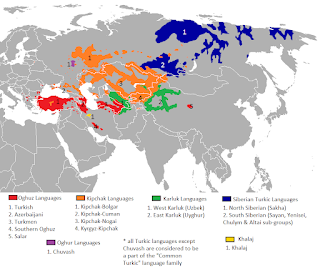
Turkish is a member of the big Turkic languages family that is thought to have originated in East Asia, in the area stretching from Mongolia to North Western China.
It belongs to Oguz (western) branch of the family.
The migrations and conquests of nomadic Turkic tribes brought their language to Western Asia and the Balkans.
In modern times immigrants brought their language to Western Europe, mainly Germany.
Turkic languages
Turkish is the most widely spoken language of the family with an estimate of about 70 to 80 million speakers.
Their common traits are vowel harmony, agglutination (the use of many prefixes and suffixes in one word) and no grammatical gender.
Turkish is a very logical language grammatically with few exceptions and not that hard to learn for English speakers.
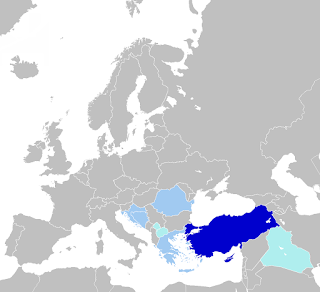
Countries with substantial numbers of Turkish speakers. Germany is one too.
It is written in a variant of the Latin alphabet introduced by reforms of Kemal Ataturk meant to westernise the country.
Formerly the Ottoman alphabet was used the so-called and Turko-Arabic script based on Arabic which was the official alphabet of the Ottoman administration.
The Ottoman alphabet was abolished with the introduction of the new Turkish alphabet.
Turkish personal pronouns can be divided into several categories based on their grammatical function. Here are the main categories of Turkish personal pronouns with examples:
1. Subject pronouns:
- Ben (I): Ben Türkiye'de yaşıyorum. (I live in Turkey.)
- Sen (You - singular informal): Sen çok güzelsin. (You are very beautiful.)
- O (He/She/It): O bugün işe gitmedi. (He/She/It did not go to work today.)
- Biz (We): Biz yarın okula gideceğiz. (We will go to school tomorrow.)
- Siz (You - plural or singular formal): Siz buraya nasıl geldiniz? (How did you get here?)
- Onlar (They): Onlar çok mutlular. (They are very happy.)
2. Object pronouns:
- Beni (Me): Beni ara. (Call me.)
- Seni (You - singular informal): Seni seviyorum. (I love you.)
- Onu (Him/Her/It): Onu gördüm. (I saw him/her/it.)
- Bizi (Us): Bizi bekleyin. (Wait for us.)
- Sizi (You - plural or singular formal): Sizi tanıyorum. (I know you.)
- Onları (Them): Onları davet etmedik. (We did not invite them.)
3. Possessive pronouns:
- Benim (My): Benim arabam var. (I have a car.)
- Senin (Your - singular informal): Senin evin çok güzel. (Your house is very beautiful.)
- Onun (His/Her/Its): Onun çantası kayboldu. (His/Her/Its bag got lost.)
- Bizim (Our): Bizim okulumuz büyük. (Our school is big.)
- Sizin (Your - plural or singular formal): Sizin işiniz ne? (What is your job?)
- Onların (Their): Onların çocukları var. (They have children.)
4. Reflexive pronouns:
- Kendim (Myself): Kendim için bir hediye aldım. (I bought a gift for myself.)
- Kendin (Yourself - singular informal): Kendinize iyi bakın. (Take care of yourself.)
- Kendisi (Himself/Herself/Itself): Kendisi ile konuşun. (Talk to him/her/it.)
- Kendimiz (Ourselves): Kendimiz için bir tatil planladık. (We planned a vacation for ourselves.)
- Kendiniz (Yourselves - plural or singular formal): Kendinizi rahat hissedin. (Make yourselves comfortable.)
- Kendileri (Themselves): Kendileri için bir parti düzenlediler. (They organized a party for themselves.)
khaj-khat kherj rowety - Warfare against foreign enemies
khaj-khat en neb - Warfare led by the king
nḫt (nekh-t) - Battle
𓈖𓄿𓌨𓏏
nekh-t en neb - The battle of the king
nekh-t rowety - Battle against enemies
tpy (t-p-y) - To Fight
𓏏𓊵𓇳
t-p-y en rowety - Fighting against enemies
t-p-y en neb - Fighting for the king
ḫr (kher) - To Destroy
𓐍𓂧
kher rowety - Destruction of enemies
kher neb - Destruction of the enemy's power
nḥm (nekh-em) - To Smite
𓈖𓎛𓅱
nekh-em kherj - Smiting the enemy
nekh-em en neb - Smiting for the king
ḫꜥ (kha) - Army
𓄿𓌨
kha neb - The king's army
kha en rowety - The army of the enemies
ḥꜣt (hat) - Soldier
𓎛𓄿𓍯
hat neb - The king's soldiers
hat rowety - The soldiers of the enemies
nb (neb) - Lord, Ruler
𓎟
neb en neb - The king of kings
neb t-p-y - The ruler who fought
nṯr (neter) - God, Divine
𓊵
neter neb - The divine king
neter en rowety - The divine enemy
ḫrj (kherj) - Enemy
𓐍𓂧𓏭
kherj neb - The king's enemy
kherj en rowety - The enemy of enemies
Battle Dialogue
General: Aha khefty Hyksos em Avaris?
Will you fight the Hyksos enemy at Avaris?
Soldier: Aha mesha en Ahmose khefty Hyksos.
I will fight in Ahmose’s army against the Hyksos.
General: Sekher khefty neb en Kemet?
Will you overthrow the enemy for Egypt’s king?
Soldier: Sekher khefty Hyksos en Kemet.
I will overthrow the Hyksos for Egypt.
General: Nekht em Avaris nefer!
Victory at Avaris is good!
Soldier: Nekhtet en neb!
Thanks to the king!
History of the Hyksos
The Hyksos were a group of people who migrated into ancient Egypt from the eastern Mediterranean region around the 17th century BCE. They were likely a mixed group of people, including Semitic-speaking individuals from Western Asia and Hurrian and Kassite people from the area of modern-day Iran.
The Hyksos established their capital at Avaris, in the eastern delta region of Egypt, and began to exert their influence over the northern part of the country. They introduced new military technology, such as the chariot, and they also introduced new cultural and religious practices.
The Hyksos ruled Egypt for about 100 years, during a period known as the Second Intermediate Period. However, they faced increasing resistance from the native Egyptians, who eventually rallied under the leadership of a series of pharaohs from the Theban region in southern Egypt.
The most famous of these pharaohs was Ahmose I, who is credited with launching the successful campaign to expel the Hyksos from Egypt. Ahmose I was able to unite the various factions within Egypt and build a powerful army that was able to defeat the Hyksos in a series of battles. The final battle took place at the city of Avaris, which was the Hyksos capital, and the Egyptians were able to breach the city walls and capture the city.
With the defeat of the Hyksos, Egypt entered the New Kingdom period, which was marked by a renewed sense of national pride and a period of great prosperity and cultural achievement.
Explanatory Video
Ancient Egyptian Archers
An Ancient Egyptian archer caricature.
Ancient Egyptian archers were a vital part of the military, skilled in the use of composite bows. They played a significant role in battles, providing ranged support and defending fortifications. Archers were often recruited from the lower classes and trained extensively, with depictions showing them in action during campaigns like those of Ramses II.
These archers used advanced techniques, including shooting from chariots, which gave them mobility and precision. Their arrows, tipped with flint or bronze, were effective against both infantry and cavalry, contributing to Egypt's military success during the New Kingdom period.
Write, stack and arrange Egyptian hieroglyphs — with the full Gardiner
sign list, including an extended repertoire of thousands of PUA
(Private Use Area) glyphs.