Search This Blog

FOLLOW ME

Showing posts with label Ancient Greek. Show all posts

Monday, January 3, 2022

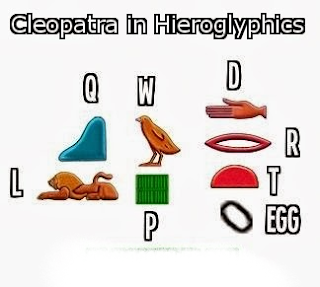
Cleopatra in Hieroglyphics


Cleopatra in Egyptian hieroglyphs was written as qljwp3drt3 -all consonants- hence Cleopatra.

only consonants
Ancient Egyptians used mainly consonants to write much like in Semitic languages.

The j,w,3 signs in the name are in fact consonants which we assume that were followed by i,o,a vowels accordingly.We cannot be sure about which vowels followed in the spoken language.So,we simply write i,o,a for ease of reading.

For example,the vulture sign is actually the '3' consonant followed by A.We just write it as A.

Vulture sign
'A' in Hieroglyphics

the egg determinative
At end it is used the egg determitative which means son,humanity and it is a common determitative for the name of goddesses.For example it was commonly used to write the name for Egyptian goddess Isis.
Garder listed it as H8.
the egg determinative sign

Being a determinative the egg is not read here.The word for egg in Egyptian was swht.

Cleopatra used this determitative for her name,too.


Variations

Of course there are other ways to write the name Cleopatra in hieroglyphics.Here is another one.


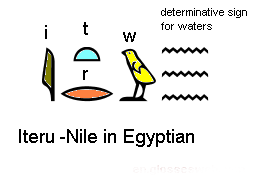
Nile in Egyptian Hieroglyphics

The river Nile is the longenst river in the world.It has always been a vital life source for Egypt and Sudan.In ancient Egyptian it was called iteru or Ḥ'pī .Hapi was the Egyptian god of the Nile flooding ,a symbol of abundance and prosperity.


The name's origin is unknown,possibly related to Semitic nahal for river.

The hieroglyphics below should be read left to right- the bird is facing left- and top to bottom.The last character is a determinative for waters that indicates the meaning of the word and it is not read.

direction of writing


The Nile River was of tremendous importance to the people of Ancient Egypt. It was the primary source of water and fertile soil in an otherwise arid region, and it played a central role in the religious beliefs and cultural practices of the ancient Egyptians.

Some common phrases in ancient Egyptian related to the Nile include:

1. Hapi: This was the name of the god of the Nile, who was believed to control the river's flooding and bring fertility to the land. The ancient Egyptians often offered prayers and sacrifices to Hapi to ensure a bountiful harvest.

2. Iteru: This was the ancient Egyptian name for the Nile River. It was sometimes referred to as "the great river" or "the mother of all life."

3. Akhet: This was the season of the year when the Nile flooded, typically occurring from June to September. The ancient Egyptians celebrated the flooding as a time of renewal and fertility.

4. Shemu: This was the season following the flooding, when the land was irrigated and crops were planted. It typically occurred from October to February.

5. Peret: This was the season of the year when the crops were harvested. It typically occurred from March to May.

The Nile River also played a significant role in the mythology and symbolism of ancient Egypt. The annual flooding of the Nile was seen as a symbol of rebirth and regeneration, and it was often depicted in art and architecture as a source of life-giving water. The Nile was also associated with the goddess Isis, who was believed to have protected the river and its people.

Tuesday, December 28, 2021

Albanian movies with English subtitles.

Watching movies is a great way to learn languages.  But it should be done the right way. 

You can't start watching movies in the foreign language right way. I found it very helpful at first  to watch a movie in English with foreign subtitles.

 Then move on to a movie in foreign audio with English subtitles. When you are good enough and your level of understanding has improved the next step would be foreign audio with foreign subtitles.

 The last and final stage should be foreign audio only.


The movies below is in English mainly with lots of Albanian subtitles.  Very helpful.


Wednesday, June 23, 2021

Meeting people in Ancient Greek.

Ancient Greek: Self-Introduction
Name | Origin | Age | Profession | Grammar Notes

Grammar: Ancient Greek Basics

Dative for "to me": μοι = "to me" (used in name answers)

Verb "εἰμί": Present tense of "to be" — no subject pronoun needed

Questions: τίς, τί = who/what; ποδαπός = from where

Prepositions: ἐκ / ἀπό + genitive = "from"

Word Order: Flexible — emphasis on first word

Ὄνομα σοι τί ἐστιν; (Ónoma soi tí estin?)
What is your name?
Lit: "Name to-you what is?"
Ὄνομά μοι ἐστίν Ἰωάννης. (Ónoma moi estin Iōánnēs)
My name is John.
Replace Ἰωάννης with your name
Ὄνομά μοι Μαρία. (Ónoma moi María)
My name is Maria.
Ὄνομα μοι... (Ónoma moi...)
My name is...
Shorter form — common in dialogue
Ποδαπὸς εἶ; (Podapós eí?)
Where are you from? (to male)
Ποδαπὴ εἶ; (Podapḗ eí?)
Where are you from? (to female)
Ποδαποί ἐστε; (Podapoí este?)
Where are you from? (plural)
Καὶ ποδαπός; (Kaì podapós?)
And where are you from?
Ἐκ Ἀθηνῶν ἔρχομαι. (Ek Athēnôn érkhomai)
I come from Athens.
Ἐκ τῆς Ἑλλάδος εἰμί. (Ek tês Helládos eimí)
I am from Greece.
Ἐκ Σκυθίας εἰμί. (Ek Skythías eimí)
I am from Scythia.
Πόθεν εἶ; (Póthen eí?)
Where are you from? (alternative)
Ποῦ κατοικεῖς; (Poû katoikeîs?)
Where do you live?
Ἐγγύτατα οἰκῶ. (Engýtata oikô)
I live nearby.
Τηλοῦ οἰκῶ. (Tēloû oikô)
I live far away.
Ἐν ᾿Αθήναις οἰκῶ. (En Athḗnais oikô)
I live in Athens.
Πηλικὸς εἶ; (Pēlikós eí?)
How old are you? (to male)
Πηλικὴ εἶ; (Pēlikḗ eí?)
How old are you? (to female)
Ἔτεα πέντε γεγονώς. (Étea pénte gegonṑs)
I am five years old. (male)
Ἔτεα πέντε γεγονυῖα. (Étea pénte gegonuîa)
I am five years old. (female)
Ἔτεα τριάκοντα γεγονώς. (Étea triákonta gegonṑs)
I am thirty years old. (male)
Τίς ἐστιν ἡ τέχνη σου; (Tís estin hē tékhnē sou?)
What is your profession?
Γιατρός εἰμι. (Giatrós eimi)
I am a doctor.
Στρατιώτης εἰμι. (Stratiṓtēs eimi)
I am a soldier.
Φιλόσοφος εἰμι. (Philósophos eimi)
I am a philosopher.
Πόσον χρόνον ἐν Ἀθήναις εἶ; (Póson chrónon en Athḗnais eî?)
How long have you been in Athens?
Πέντε ἔτη ἐν Ἀθήναις διατρίβω. (Pénte étē en Athḗnais diatríbō)
I have been in Athens for five years.

Ancient Greek Conversation:

Ὄνομα σοι τί ἐστιν;
Ὄνομά μοι ἐστίν Ἀλέξανδρος.
Ποδαπὸς εἶ;
Ἐκ Μακεδονίας ἔρχομαι.
Ποῦ κατοικεῖς;
Ἐν Ἀθήναις οἰκῶ.
Πηλικὸς εἶ;
Ἔτεα τριάκοντα γεγονώς.
Τίς ἐστιν ἡ τέχνη σου;
Στρατηγός εἰμι.

Friday, May 14, 2021

Greetings in Ancient Greek

Ancient Greek Greetings

Ancient Greek Greetings

Illustration of Ancient Greek culture

Χαῖρε

Khaíre! (sg)

Greetings

Χαίρετε

Khaírete! (pl)

Greetings

Χαῖρε, ὦ φίλε!

Khaīre, ō fíle!

Greetings, o friend!

Χαῖρε Καῖσαρ!

Khaīre, Kaīsar!

Hail, Caesar!

χαῖρε καί ὑγίαινε

Khaīre kai ygíaine

Greetings and good health

Παῦλος ἐπέστειλε φράσαι χαίρειν.

Paulos epesteile phrasai khaírein.

Paul says hello. (He sends greetings)

Ἀσπάζομαι

Aspázdomai

I kiss you.

πῶς ἔχεις;

Pō̂s ékheis?

How are you doing?

ἔχω καλῶς

Ékhō kalō̂s.

I'm fine.

ἔρρωσο

Erroso

Be well

Καιρὸς δέ!

Kairòs dé!

Long time no see.

Ὑγίαινε

Hygíaine! (sg)

Good health

καὶ σύγε!

Kaì sýge!

You too!

Ὑγιαίνετε

Hygiaínete! (pl)

Good health

εὔχομαι σε ὑγιαίνειν

Eukhomai se ugiainein

I pray you to be well.

Ὑπίαινε

Hypíaine! (sg)

Goodbye

Ὑπιαίνετε

Hypiaínete! (pl)

Good health

εὐτύχει

Eutukhei

Be prosperous!

εὐτυχεῖτε

Eutukheite

Be prosperous!

App

📜 Discover Glyphscribe!

Dive into the fascinating world of hieroglyphics with this fun, educational keyboard app.
Install now and start typing with ancient symbols!

📱 Install Now

Available on Google Play • Updates automatically

Recent comments

Followit

Popular

Scroll to top