Search this

Search Posts

Archive
Blogger Search

FOLLOW ME

Friday, April 14, 2023

The verb to be in Greek

Greek Verb: Είμαι (to be) – Full Guide
Present Tense | Questions | Identity | Grammar Notes

Grammar: The Verb "Είμαι" (to be) – Present Tense

Usage: Describes identity, location, profession, nationality, feelings, and temporary states.

Key Rule: No subject pronoun needed in Greek — the verb ending tells you who!

Gender Note: "Ποιος/Ποια/Ποιο" changes by gender of the person asked.

PersonGreekRomanizationEnglish
1st sg.Εγώ είμαιe-GHO EE-mehI am
2nd sg.Εσύ είσαιe-SEE EE-sehYou are (informal)
3rd sg.Αυτός/Αυτή/Αυτό είναιaf-TOS / af-TEE / af-TOH EE-nehHe / She / It is
1st pl.Εμείς είμαστεe-MEES EE-mah-stehWe are
2nd pl.Εσείς είστεe-SEES EE-stehYou are (formal/plural)
3rd pl.Αυτοί/Αυτές/Αυτά είναιaf-TEE / af-TES / af-TAH EE-nehThey are (m/f/n)
Είμαι (EE-meh)
to be (infinitive form – used in titles)
Εγώ είμαι ο Γιάννης. (e-GHO EE-meh oh YAH-nees)
I am Yiannis. (male)
ο = masculine article
Εγώ είμαι η Μαρία. (e-GHO EE-meh ee mah-REE-ah)
I am Maria. (female)
η = feminine article
Εσύ είσαι ο φίλος μου. (e-SEE EE-seh oh FEE-los moo)
You are my friend. (to a male)
Εσύ είσαι η φίλη μου. (e-SEE EE-seh ee FEE-lee moo)
You are my friend. (to a female)
Αυτός είναι ο δάσκαλος. (af-TOS EE-neh oh THAH-skah-los)
He is the teacher.
Αυτή είναι η δασκάλα. (af-TEE EE-neh ee thah-SKAH-lah)
She is the teacher.
Εμείς είμαστε φοιτητές. (e-MEES EE-mah-steh fee-tee-TES)
We are students. (group with males)
Εμείς είμαστε φοιτήτριες. (e-MEES EE-mah-steh fee-tee-TREE-es)
We are students. (all female group)
Gender Agreement: Use Ποιος for males, Ποια for females, Ποιο for neuter (rare in identity).
Ποιος είσαι εσύ; (PYOS EE-seh e-SEE?)
Who are you? (to a male)
Answer: Είμαι ο Κώστας.
Ποια είσαι εσύ; (PYAH EE-seh e-SEE?)
Who are you? (to a female)
Answer: Είμαι η Ελένη.
Πώς σε λένε; (POS se LEH-neh?)
What is your name? (lit. "How do they call you?")
More natural than "Ποιος είσαι"
Με λένε Άννα. (meh LEH-neh AH-nah)
My name is Anna. (lit. "They call me Anna")
Είμαι Έλληνας. (EE-meh EH-lee-nas)
I am Greek. (male)
Είμαι Ελληνίδα. (EE-meh eh-lee-NEE-tha)
I am Greek. (female)
Είμαι από την Αμερική. (EE-meh ah-PO teen ah-meh-ree-KEE)
I am from America.
Είμαι από την Αγγλία. (EE-meh ah-PO teen ang-LEE-ah)
I am from England.
Είμαι από την Ελλάδα. (EE-meh ah-PO teen eh-LAH-thah)
I am from Greece.
Είμαι γιατρός. (EE-meh yah-TROS)
I am a doctor. (male)
Είμαι γιατρίνα. (EE-meh yah-TREE-nah)
I am a doctor. (female)
Είμαι δάσκαλος / δασκάλα. (EE-meh THAH-skah-los / thah-SKAH-lah)
I am a teacher. (m/f)
Είμαι φοιτητής / φοιτήτρια. (EE-meh fee-tee-TES / fee-tee-TREE-ah)
I am a student. (m/f)
Είμαι κουρασμένος. (EE-meh koo-rahz-MEH-nos)
I am tired. (male)
Είμαι κουρασμένη. (EE-meh koo-rahz-MEH-nee)
I am tired. (female)
Είμαι χαρούμενος / χαρούμενη. (EE-meh khah-ROO-meh-nos / khah-ROO-meh-nee)
I am happy. (m/f)
Είμαι πεινασμένος / πεινασμένη. (EE-meh pee-nahz-MEH-nos / pee-nahz-MEH-nee)
I am hungry. (m/f)
Είμαι στο σπίτι. (EE-meh stoh SPEE-tee)
I am at home.
Είμαι στην Αθήνα. (EE-meh steen ah-THEE-nah)
I am in Athens.
Είμαι εδώ. (EE-meh eh-THOH)
I am here.

First Meeting:

— Γεια σου! Ποιος είσαι;
— Είμαι ο Πέτρος. Και εσύ;
— Είμαι η Σοφία. Από πού είσαι;
— Είμαι από την Κρήτη. Εσύ;
— Είμαι από την Αθήνα. Είσαι φοιτητής;
— Ναι, είμαι φοιτητής.

Tuesday, April 4, 2023

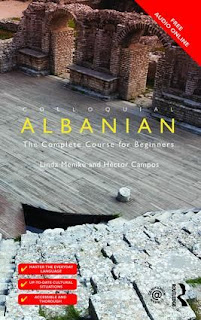
Colloquial Albanian (book review)

Colloquial Albanian Book Review

Review: Colloquial Albanian (Latest Edition)

I recently purchased the latest edition of the Colloquial Albanian book from the renowned Colloquial series, and I must say—it’s one of the best tools I’ve come across for learning Albanian. A very pleasant surprise!

Colloquial Albanian Latest Edition
Colloquial Albanian – Latest Edition

What I Liked

  • Clear and digestible lessons with simple grammar explanations and examples.
  • More user-friendly than the older edition, which felt dense and bloated.
  • Aligns with the official Albanian (Tosk dialect), as spoken in Albania.
  • Includes practical, real-life word/phrase variants used by native speakers.
  • Dialogue exercises that genuinely help you begin speaking Albanian.
Old vs. New Edition: Kosovan Elements Explained

The older edition contains many elements of the Kosovan dialect, which is based on the Gheg variant of Albanian. This is problematic for learners wanting to study the standard Albanian language, which is based on the Tosk dialect and used in Albania’s official education system.

Examples of Dialect Differences:

  • Gheg (Kosovan): "kam me shku" – I will go
    Tosk (Standard): "do të shkoj"
  • Gheg: "çka" – what
    Tosk: "çfarë"
  • Gheg: "po du" – I want
    Tosk: "dua"
  • Gheg: "qysh je?" – how are you?
    Tosk: "si je?"

These differences are not just grammatical—they influence pronunciation, sentence structure, and word choice. The old edition makes no mention of these dialect distinctions, which can lead to confusion or learners unintentionally adopting Kosovan forms.

Older Edition
Older edition – contains many Kosovan/Gheg dialect forms.

Thankfully, the new edition sticks to the official Tosk-based standard, making it more reliable for learners aiming for proficiency in Albanian as spoken in Albania.

Audio Materials

Free & Fast: The complete audio is freely available on the official Colloquial website—there’s really no reason to purchase the CDs.

However, a downside is that several dialogues are spoken at a very fast pace. This makes them difficult to follow for beginners. The editors should ideally have recorded at a slower, learner-friendly speed.

Drawbacks

  • Errors: Like many books in the Colloquial series, this edition contains numerous printing errors, especially in the answer key.
  • Overly Complex Grammar: Some explanations are too long and convoluted, making them difficult to grasp.
  • Proofreading: Considering the book’s cost, the lack of editorial care is disappointing.

Conclusion

Despite its shortcomings, this book is one of the best Albanian learning resources available. It's modern, clear, and practical—an essential pick for serious learners.

Monday, May 30, 2022

Some Albanian verbs


banoj
I live,I stay

bëj
I do

dërgoj
I send
 
Filloj
I start

Ha I eat

Gjej  
I find

Harroj
I forget

Humbas
I lose

Jam
I am

Jetoj
To live

Kam
I have

Kaloj
to pass by

Kerkoj 
I look for

Mendoj
I think

Nderoj
I change

Ndihem
I feel

Ndihmoj
I help

Përfundoj
I end

Pres
I wait

qelloj 
I shoot 

Qëndroj
I stay

rri- 
I live,I stay

Shoh
see

Shikoj
I look

Shkoj
I go

Shpresoj
I hope

Takoj
I meet

Vras
kill


Sunday, May 1, 2022

Pharaoh Khufu

Khufu – The Great Pyramid

Khufu (Cheops)

The Pharaoh Who Built the Great Pyramid

Great Pyramid

Last surviving wonder of the ancient world

Who Was Khufu?

Khufu (خُوفُو ) ruled Egypt as the second king of the 4th Dynasty from ~2589–2566 BCE. His name means "Khnum Protects Me".

Khufu statue

Only known portrait (7.5 cm ivory)

He is famous for building the Great Pyramid of Giza, the largest stone structure of antiquity.

Pharaoh → فِرْعَوْن (fir‘awn)
  • Horus Name: Medjedu
  • Golden Horus: Bikwy Neb
  • Prenomen: Khnum-Khufu
  • Original height: 146.6 m
  • Base: 230.3 m per side
  • ~2.3 million stone blocks
  • Aligned to true north within 3/60°
الْهَرَمُ الْأَكْبَرُ

Discovered in 1954: a 43.6 m cedar ship for the afterlife journey with Ra.

Quick Quiz
Khufu was the second king of the 4th Dynasty.
Khufu was the first king of the 4th Dynasty.
Pyramid height: 146.6 m
Pyramid height: 136 m
Only one statue survives.
Many statues exist.

Timeline of Khufu’s Era

~2686 BCE

Sneferu reigns

~2589 BCE

Khufu ascends

~2580 BCE

Pyramid begins

~2566 BCE

Khufu dies

Vocabulary

Pyramid → هَرَم
King → مَلِك
Eternity → خُلُود
© 2025 Ancient Egypt Learning Hub

Sunday, April 10, 2022

The Albanian Boza drink.


Një shishe dhe një gotë bozë shqiptare në një tavolinë.

A bottle and a glass of Albanian boza in a table.

shishe
bottle

gotë
glass

tavolinë
table

The Boza drink (bozë) is a traditional Albanian drink brought to the region by the Ottomans.

It is made up of corn flour, wheat flour, sugar and water rich in A,C,E and and four types of vitamin B. 

It is considered to have many health benefits.

Traditionally it was produced in Kukës North eastern Albania.


Thursday, April 7, 2022

Ukrainian core phrases

Ukrainian is an Eastern Slavic language related to Russian and Polish. It evolved from Old Church Slavonic.


Linguistically Ukrainian is something like midway between Russian and Polish closer to Russian. While there are many similarities with Russian there is heavy influence from Polish.


At some time the Kievan Rus or Ruthenia as it was later known in the West, collapsed and it's territory was divided between the Rus the part east of the river and the Grand Duchy of Lithuania west of the river.


Under the Grand Duchy of Lithuania the official language became Polish because of the fact that the nobility and big land-owners were Polish.


As a result there was heavy influence of Polish on Ukrainian.


There is a high degree of mutual intelligibility with Russian and Belorussian and as well as Polish to some extent.


A Ukrainian native speaker will understand both languages to a great extent while a Russian speaker will have great difficulty understanding Ukrainian without some knowledge of Polish.


Kievan Rus

Роусь (Old East Slavic) Garðaríki (Old Norse)

A map of later Kievan Rus' (after the death of Yaroslav I in 1054).

Knyaz Vladimir of the Rurikid dynasty hailing from Scandinavia was a major figure in the history of the Kievan Rus. He was responsible for uniting many lands under his rule and the Christianisation of the Rus. 


Embassies from various peoples came to Kiev talking about their religion. The Volga-Bulgars proposed to him to convert to Islam. When they explained the way of living and behaving in Islam-alhocohol forbidden- Vladimir came out with the famous phrase 'Drinking is the joy of the Rus'.

Instead his embassy to Byzantine Constantinople came back with descriptions about how grandiose and imposing was the Church of Aghia Sophia. When they heard the Byzantine liturgical chanting they explained they thought they were in heaven.

Ukrainian greetings

Ukrainian Greetings

Ukrainian Greetings

Cartoon Ukrainian flag
A cartoon Ukrainian flag, symbolizing Ukrainian language and culture.

Basic Greetings

Привіт! (Pryvit!)

Translation: Hello!

Здрастуйте! (Zdrastuyte!)

Translation: Hello!/Greetings!

Vocabulary

  • привіт - hello
    Grammar: Interjection, informal greeting.
  • здрастуйте - hello/greetings
    Grammar: Formal greeting, plural form.

Test Your Knowledge

What does "привіт" mean?

Time-Based Greetings

Доброго ранку! (Dobroho ranku!)

Translation: Good morning!

Доброго дня! (Dobroho dnia!)

Translation: Good day!

Добрий вечір! (Dobryi vechir!)

Translation: Good evening!

Vocabulary

  • доброго - good
    Grammar: Adjective in genitive case, used with time.
  • ранку - morning
    Grammar: Genitive of "ранок," masculine noun.
  • дня - day
    Grammar: Genitive of "день," masculine noun.

Test Your Knowledge

What does "доброго дня" mean?

Casual Questions

Як справи? (Yak spravy?)

Translation: How are you?

Що нового? (Shcho novoho?)

Translation: What's new?

Vocabulary

  • як - how
    Grammar: Interrogative adverb.
  • справи - affairs/how are you
    Grammar: Plural noun in accusative case.
  • нового - new
    Grammar: Genitive of "новий," adjective.

Test Your Knowledge

What does "як справи" mean?

Holiday Wishes

З Новим роком! (Z Novym rokom!)

Translation: Happy New Year!

Щасливого Різдва! (Shchaslyvoho Rizdva!)

Translation: Merry Christmas!

З Днем народження! (Z Dnem narodzhennya!)

Translation: Happy birthday!

Відчуйте себе як вдома! (Vidchuyte sebe yak vdoma!)

Translation: Make yourself at home!

Vocabulary

  • з - with
    Grammar: Preposition, used in wishes.
  • новим - new
    Grammar: Instrumental case of "новий," adjective.
  • різдва - Christmas
    Grammar: Genitive of "Різдво," neuter noun.

Test Your Knowledge

What does "з новим роком" mean?

Full Dialogue

Ukrainian:

A: Привіт! Як справи?

B: Доброго дня! Усе добре, дякую. А ти?

A: Добре, дякую! З Новим роком!

B: Дякую! Щасливого Різдва!

Translation:

A: Hello! How are you?

B: Good day! All good, thank you. And you?

A: Good, thank you! Happy New Year!

B: Thank you! Merry Christmas!

App

Sesh Nesu — Royal Scribe

Write, stack and arrange Egyptian hieroglyphs — with the full Gardiner sign list, including an extended repertoire of thousands of PUA (Private Use Area) glyphs.

sš nsw
Royal Scribe
⬇ Download Sesh Nesu

Recent comments

Popular

Scroll to top